

Normal vs. Natural
How big should a book be?
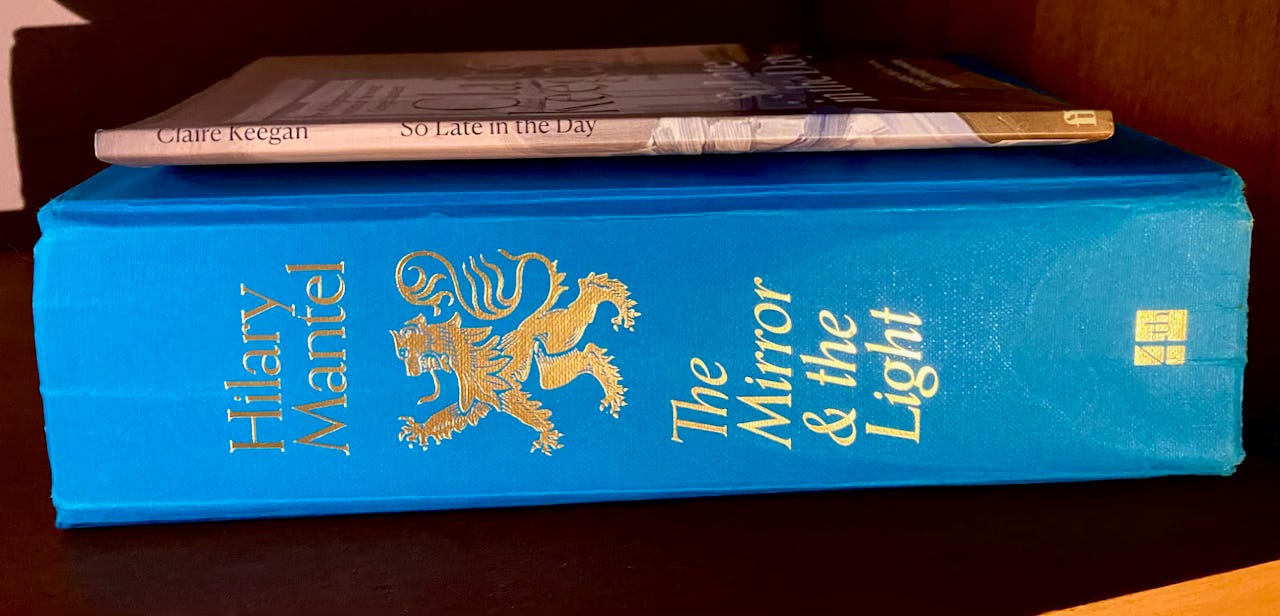
Writers can feel compelled to fill out a book to a “normal” length, or, to the contrary, to cut down a book to a “normal” size. For the publisher or editor. To make it fit the mould.
However, art-making is an exercise in absolute freedom, publishing industry norms notwithstanding.
A writer must follow their instincts, and include all the words they believe to be necessary and exclude all the words they believe to be unnecessary. And let the chips fall where they may.
Sometimes this will result in a long, wordy book, such as Hilary Mantel’s “The Light and the Mirror” (2020)—875 pages and the third part of a trilogy comprising nearly 2,000 pages. Throughout her “Wolf Hall” trilogy, Mantel uses words like the impressionists used paints—generously—to depict scene and atmosphere and reveal the inner motivations of an enormous cast of characters (we are talking the court of Henry VIII, after all). Surprisingly, in her memoirs and contemporary fiction, Mantel is queen of spare, incisive writing; a model of economy. One can only admire the flexibility of her writing skills! She naturally deploys her words according to the effect she wants to produce.
And then there is the beautiful novel (novella?) “So Late in the Day” (2023), by Claire Keegan, which fills out a mere forty-seven pages with generous margins. Could this be a short story in disguise? Indeed, it was originally published as a story in French under the title “Misogynie”, then as a story in the New Yorker, then tweaked and tightened even more before being published as a book. So let’s just call it a book. A small book with an enormous emotional impact, that naturally uses just the right words to produce the desired effect.
Keegan has stated that she “never tried to write quickly”, rather speaking of getting “the text right”.
She explains, with a laugh at the end: “I do think no story has ever been read properly unless it’s read twice. So it’s a longer book, you see, than you think it is, because it needs to be read twice. Double the pages”.
We—the delighted readers—thank the respective editors for publishing such books at their natural, if “abnormal”, length.
Every project has its unique size; no one wants to read Keegan plumped up with filler, or Mantel’s historical fiction shorn of its expressive trappings.
We can allow ourselves the very same freedom.
Most writers may not yet be as hallowed as Keegan or Mantel—nonetheless, take heart and stick to your guns!
I've written two types of books over the decades: too long and too short, sometimes both at the same time!
The natural is like taking a deep breath and sighing - just write.
What the cookie-cutter big publishing demands is make it 300 +/- Why?
The story takes as long as it takes.
But the publishing world is another country of rules.